

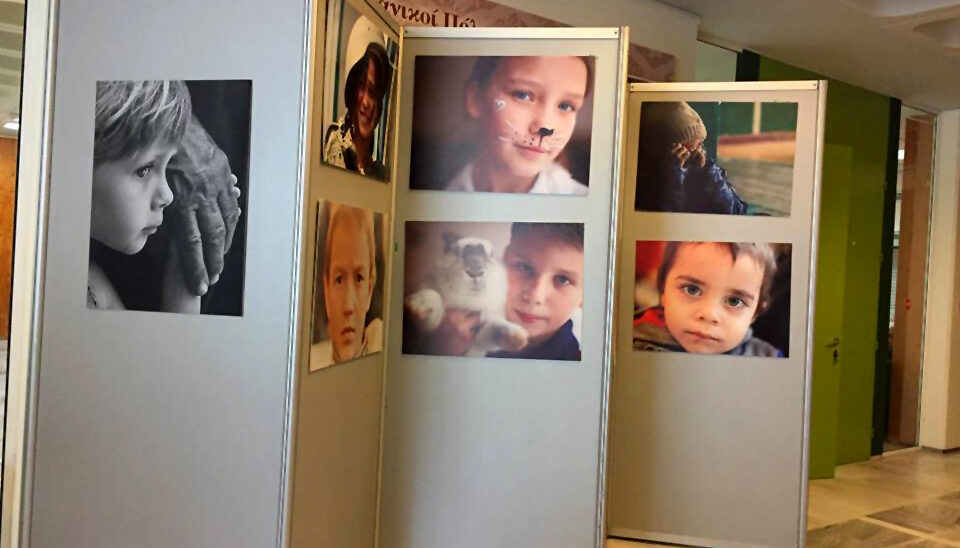
“Children in War” in the context of the conference in Athens. “European safety: Eastern Europe – Ukraine – Greece. Modern international relations. Perspectives and consequences for the world’s safety”
Athens, Greece.
The conference “European safety: Eastern Europe – Ukraine – Greece. Modern international relations. Perspectives and consequences for the world’s safety” took place on the 25th of November 2016 in the city of Athens, the capital of Greece. The conference was a great success. The event was exceptionally well-organised. It took place in the building that belonged to one of Attica’s municipalities, namely Papaga-Kholarga and drew attention of the respected Greek audience.
The conference program was thoroughly planned by the organisers and not only evoked interest among the Greek community and the representatives of Ukrainian community of the city of Athens but also among various professionals. They included war experts, analysts, journalists as well as representatives of the diplomatic сabinet, accredited in Greece. In particular, Jordanian, Greek and Croatian ambassadors, Bulgarian and Albanian military attachés and the former military attaché of the Greek Embassy in Ukraine participated in the conference as well as many other experts.
Dr. Atanasios Drugos, the scholar, analyst, expert in international safety and strategic analysis, famous in Greek and global circles , who also specialises in the matters related to the post-Soviet states, was exceptional in his role as a conference moderator. He also presented his paper on the topic “Relationship between Moscow and the West after 2014. How to tackle asymmetric hybrid threats in an ambiguous global situation in the era of Donald Trump”.
Galyna Maslyuk, the head of the Association of Ukrainian diaspora in Greece, opened the conference with a greeting:
“Ukraine is a peaceful country. It is friendly towards Greece because the great Greek community of Ukraine always was a bridge between our countries. Considering that Ukraine had only been independent for 25 years after the collapse of the Soviet empire, it is understandable that Ukraine is interested in maintaining friendly relations with all the neighbouring countries as well as those countries in the Euro-Atlantic region.”
Lady Maslyuk wished the conference participants all the best with their fruitful and interesting work. She also added:
“We believe that such events render a great opportunity for the exchange of information and thoughts that can help to understand what is happening in the world in the context of geopolitical change”.
Maryna Diomina, the first secretary of the Ukrainian Embassy in Greece who is responsible for addressing political issues, presented on the behalf of the Ukrainian ambassador Volodymyr Shkurov.
The conference moderator, Dr. Atanasios Druhos, read in English the welcome letter, which was delivered to the Ukrainian-Greek Thought Association and the conference participants from Eugene Choliy, the president of the Ukrainian World Congress. Due to the fact that working languages of the event were English and Greek, Galyna Maslyuk read the greetings of the leader of the world’s Ukrainian diaspora in Ukrainian.
Without exception, all of the speeches were extraordinary, profound and interesting. Among the presenters, there were Ioseb Nanobashvilli, Georgian Ambassador of the Greek Republic and Serbia; Alexander Hara, diplomat, expert in external affairs, defence and national security, the director of “Maidan of Foreign Affairs”, the department of international multilateral relations; Eugene Rokytskyy, an expert in the field of international security, government relations and risk management, the president of Baltic-Black Sea Safety Confederation; Olena Prokopenko, the director of the Ukrainian representative body of the Confederation, the head of the charity project ‘Children in War”; and, of course, Dr. Atanasios Drugos, the distinguished scholar, analyst, expert in international safety and strategic analysis.
In their speeches, the presenters touched on the topics of historical links between Ukraine and Greece. They factually established that for centuries Moscow’s policy towards Ukraine was warlike and invasive, aimed at destroying the Ukrainian nation as such.
The vivid examples that support this statement include the occupation of Ukraine by the Soviet Government, Inducement of Holomor (the Hunger) during 1932 – 33 (the anniversary of Holodomor is commemorated in Ukraine and around the world to this day), the World War II, Stalin’s repressions, oppression of Ukrainian language by the Soviet government and masked economic and energy wars that Russian Federation led against Ukraine for the last 25 years. The tipping point had been the occupation of Crimea and the war in the East of Ukraine
It was clearly revealed from the speakers’ presentations that separatism is not a form of democracy in Ukraine because it is not a conscious expression of freedom by the people but rather the result of the influence of propaganda and disinformation of the population for many years as well as obstinate economic policy, promulgated by Ukrainian politicians.
When considering the question of Black-sea region, it leads to the conclusion that that part of the region has a great strategic meaning in the geopolitical positioning of forces. Therefore, Kremlin needs the region to satisfy its imperialist ambitions. Russia’s positioning of Baltic Sea Fleet bases in Crimea was a strategically calculated step. That’s why the main separatist movements were incited in the regions of Donetsk, Luhansk, Kharkiv, Zaporizzhya and Odesa.
The annexation of Crimea, the occupation of the Eastern part of Ukraine, an attempt to destabilise the Odesa region were all parts of the geopolitical strategy of Moscow.
Lenient foreign policy by the US led to the rise of Russia as a military aggressor who unprecedently violates international conventions and agreements, international law and their own constitution and neglects their responsibilities.
At this point, the Russian Federation is the No 1 “destabiliser” of the geopolitical situation in the world.(Ukraine, Syria, Turkey, “frozen” conflicts, the militarisation of Crimea etc).
The Russian Federation led the information war in Europe already for years, spreading untruthful and twisted facts. As a result, we can see the victory of pro-Russian political parties in some European countries.
Georgia like no other country understands the modern problems of Ukraine and expresses its support. Ukraine and Georgia share together the European democratic values. The both countries,however, deem the actions of the EU as slow and inadequate.
Ignoring “the Ukrainian question”, accepting and supporting economic and political decisions that benefit Russia puts at risk the entire developed world. Even Greece may become the next source of ethnically-nationalistic conflict.
The views differ in relation to an unexpected victory of Donald Trump in the presidential elections in USA . However, it is agreed by everyone that it is too early to forecast any predictions as the main governing positions in the country are not yet determined.
Also, Yuriy Federov, a famous analyst and an associated member of the Russian-Euroasian program of the Royal Institute of International Affairs (London), presented his book “Hybrid War A La Russe” during the time of the conference. In his work, the scholar briefly yet comprehensively breaks down old and new myths around the Russian aggression against Ukraine, explaining how the Russian propaganda worked in Ukraine and how it is happening in Europe. In his book, Mr Federov mentions specific political parties and names of those who come from different European countries, including Greece and who are the allies and advocates of the Kremlin and its policies.
The photo exhibition “Children in War” and the documentary “Operation “Wave”” had a great impression on the attendants. Using real life examples and historical archives , they showed a chain of systematic oppression of Greeks by Moscow. From Katherine II, when Greeks were displaced from Crimea to Pryazovia which caused a lot of deaths; Stalin repressions when thousands of Greeks were shot and there was no judicial process or investigation in place; until modern day, when the whole Pryazovian region was on the frontline because of the Russian aggression. And children who lived there lost a part of their childhood. The youngest don’t even know what the life is like without everyday shootings.
It is impossible not to consider the fact that obstinate pro-Russian supporters in Athens put the maximum effort into interrupting the event and the conference itself.
Despite that, everything went in accordance with the plan and the event was a success. The video recordings of the presentations as well as the speeches will soon be available on the websites of the organisers’ information partners.
Based on materials from the website “Ukrainian-Greek Thought”
(The link reads: in accordance with materials from the website “Ukrainian-Greek Thought”)
25 November 2016